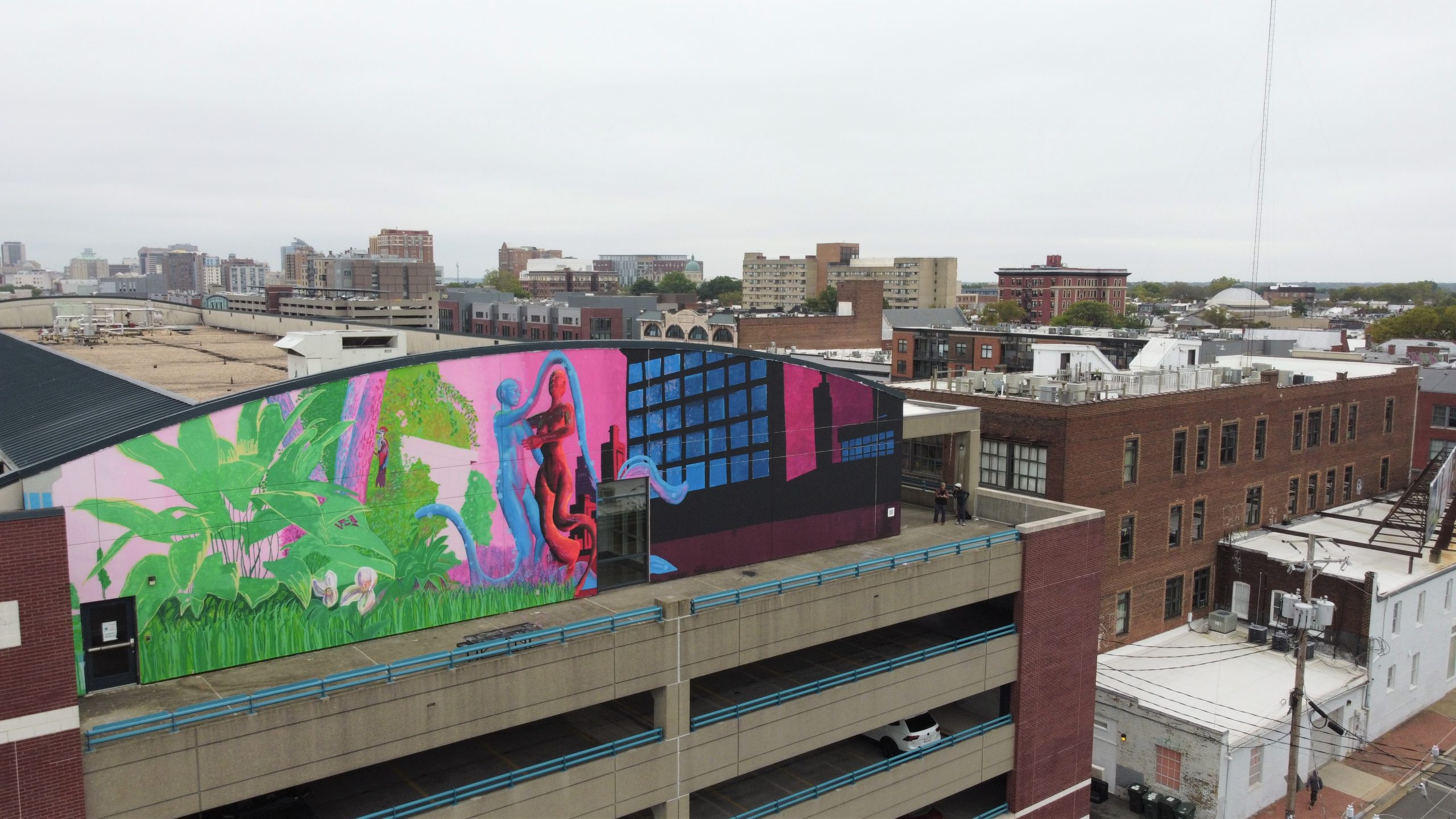
Urban Heat Island Mural
The density of materials like concrete and asphalt in urban areas increases temperatures locally, creating a much hotter environment than suburban and rural areas which have more vegetation. Richmond, the location of this mural, is one of the many cities experiencing the urban heat island effect, especially in the redlined communities of the city. Due to racist housing policies, these communities have the least access to temperature-cooling infrastructure and vegetation bearing the worst temperatures in the city.
With the help of my Academic Mentor, Roberto Jamora, I created a mural on campus property to educate VCU and local communities about the heat island effect and provided actionable information to reduce this effect with thermal painting. I used a thermal infrared camera to measure the thermal qualities of paint and purposefully painted with these properties to create temperature contrasts. When I used the thermal painting techniques, the thermal infrared camera visually captured the subjects that figuratively and literally heat or cool urban areas.
The artistic application of my paint investigated the qualitative contrasts of three methods of thermal painting. First, I measured the appearance of different gradations of tonal shades on thermal contrast. I painted the specified cities with either bright or dark shades. Second, I measured the difference in heat absorption between solar reflective paints and regular mural paints. The third area I measured is how various mark-making techniques with light and dark tones impact the surrounding temperature of the mural. The different tonal painting techniques I explored are gradients, stippling, hatching, layering, blending, and clean-cut color blocking.
With the help of my Academic Mentor, Roberto Jamora, I created a mural on campus property to educate VCU and local communities about the heat island effect and provided actionable information to reduce this effect with thermal painting.
What is thermal painting?
I used a thermal infrared camera to measure the thermal qualities of paint and purposefully painted with these properties to create temperature contrasts.
When I used the thermal painting techniques, the thermal infrared camera visually captured the subjects that figuratively and literally heat or cool urban areas.
How did you Thermal Paint?
The artistic application of my paint investigated the qualitative contrasts of three methods of thermal painting. First, I measured the appearance of different gradations of tonal shades on thermal contrast. I painted the specified cities with either bright or dark shades. Second, I measured the difference in heat absorption between solar reflective paints and regular mural paints. The third area I measured is how various mark-making techniques with light and dark tones impact the surrounding temperature of the mural. The different tonal painting techniques I explored are gradients, stippling, hatching, layering, blending, and clean-cut color blocking.